Taking the game to Jetten – Strategic consideration
“We avoid blaming and shaming. We live in a toxic system, but no one individual is to blame.”
This is the text that accompanies Principle 8. We often express it as “no shaming, no blaming.” Our Principles and Values provide a framework for how we treat one another and offer strategic grounding. Principle 8 is no exception. Both for how we treat each other and for how we mobilise effectively, it is important that our actions are accessible to a broad range of people. Shame is a barrier to that. You are not a hypocrite for speaking out on climate and the environment while driving a car and eating cheese. Climate justice concerns us all, and we all have the right to take action for it.
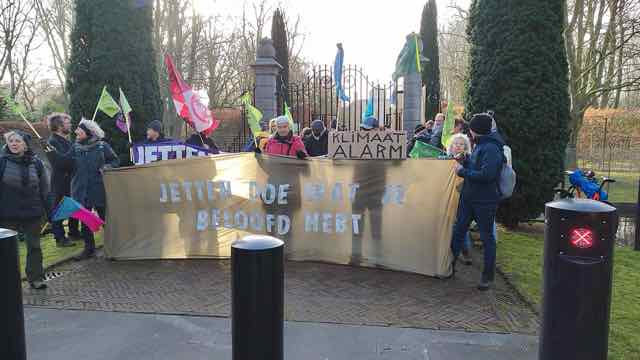
We direct those actions at companies or the government; usually not at individual CEOs or ministers, and certainly not at their staff. This too has a strategic rationale. We all live in this toxic system, forced to contribute to it in order to keep a roof over our heads and bread on the table. Moreover, climate concerns everyone. If we want to encourage people to seek work with greater social value, or to urge their representatives to speak out strongly for the climate, shaming them for their past is not useful. It is complicated to draw a line between professions and parties that are good or evil. And doubly complicated to draw a line between people who are good or evil. So however angry we may be at particular CEOs or ministers, we often choose not to draw that line in our actions.
Another important reason we do not target specific powerful individuals is that it simply appears to have little effect. CEOs are often anonymous and capture little of the public imagination. Politicians are usually well-known personalities, but they have a reputation for being untouchable. Even if we had chosen to, explicitly targeting Schoof or Rutte would have achieved little.
None of this is new information, but for this analysis it is important to recognise that our moral considerations and our practical considerations never had to grind against each other before. That is precisely why now, with the situation changed, it is worth looking at this value afresh. What opportunities are there, what room exists within our Principles and Values, and where do we (after all) draw the line?
Taking the game to Jetten
In February, the new Jetten cabinet took office. We are not the first to observe that, although the coalition agreement is unmistakably a VVD agreement, Jetten is no Rutte and D66 is no VVD. Many an NGO is busy adjusting its lobbying strategy on the premise that this prime minister is approachable, is susceptible to criticism, and will not be propped up indefinitely by his party. For XR too, this presents opportunities: taking the game to Jetten.
Jetten had the reputation of being someone with strong ideals who worked hard for them (within the system). As Minister for Climate he came to our A12 blockades and said he understood our anger. Only last year he attended the Red Line demonstrations against the genocide in Gaza, and made this part of his profile during the elections. A large part of our disappointment is that we do not see these ideals reflected in the policy of the new cabinet he leads. The cynical first thought is that those ideals were an act to gain power, but we cannot prove that. Just as plausibly, we suspect he still embraces these progressive ideals, feels remorse over falling short, and would be stung if confronted with it.
Even if it was an act: those who voted for him, or are even members of his party, embrace these ideals sincerely. Where it was clear that the VVD would always stand behind Rutte and his voters would keep voting for him, this is certainly not the case for D66. Many D66 voters were strategic voters. Voters with no loyalty to the party, who will vote differently if they are dissatisfied. By magnifying Jetten’s betrayal of his voters, we exert indirect pressure on D66 and its electorate. Even if Jetten is not personally affected by our criticism, he is sensitive to the erosion of his support base.
Playing the man, not the ball
One of the reasons we place so much emphasis on Principle 8 is that we ourselves are frequently accused of hypocrisy: “you’re only entitled to an opinion on climate once you live naked in a barrel.” We can steel ourselves against this internally, but in the public debate that accusation finds fertile ground. On other issues too, we see accusations of hypocrisy land hard; much harder than other accusations. The malicious things that took place under Rutte’s leadership never harmed him, precisely because he was not a hypocrite. By exposing Jetten’s betrayal, by confronting him with his hypocrisy, we would have an instrument that publicly wounds a prime minister.
Tearing into Jetten and D66 can also influence the broader public debate. The same voices that call us hypocrites accuse D66 of being left-wing. We need not explain here why that is nonsense, but it is important to recognise what this framing does. It equates the left with neoliberalism (something centre-left parties only feebly contest) and mainstreams right-wing conservatism. By criticising D66 from the left of the political spectrum, we detach ourselves from neoliberalism and pull the Overton window to the left. After our action disrupting the bordes ceremony at the swearing-in, there was already considerable confusion in the public debate: “weren’t we on the same side?” That confusion can be fruitful for us.
It is important to bear in mind, however, that we have only limited control over this. We speak in terms of opportunities, not guarantees. We must keep in the back of our minds that we do not let ourselves be co-opted by the system. Criticism of D66 can be read as support for another party. Something we emphatically do not want. And even if our actions lead more voters to vote for parties to the left of D66, that is not our goal. System change is necessary to combat the poly-crisis. Fighting neoliberalism and shifting the Overton window are part of that, but not goals in themselves. And this must always go hand in hand with fighting fascism, which also sees opportunities in attacking Jetten.
Our limits
The Principles and Values leave room to focus on the role an individual plays in destroying our planet: “whilst a specific campaign may seek to highlight the damaging role played by an institution, including individuals serving that institution […]”. Delineating a role, however, is no simple matter. Where does Prime Minister Jetten end and Rob begin?
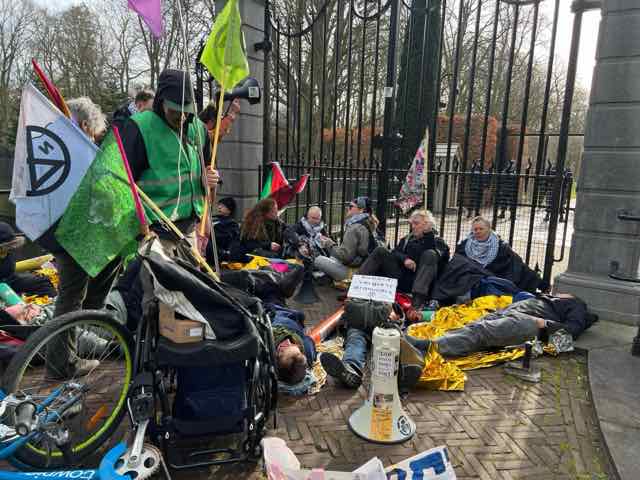
Jetten recently admitted to filing weekly police reports over homophobic threats. One of the reasons Rutte and Schoof were untouchable was that they are (ostensibly) white, privileged, cis-het men. Female, BIPOC, or LGBTQIA+ politicians do not have that privilege, and there is indeed a documented higher attrition rate among politicians from those groups. Even if we manage to aim our criticism squarely at his role as prime minister, it may well end up on the same pile as all the criticism aimed at Jetten’s identity.
Still, we must not allow Jetten to use his (relatively) marginalised status as a shield for failing policy. Moreover, the coalition agreement is hardly brimming with progressive ideas. It contains nothing, for instance, on improving trans healthcare; previously a D66 signature issue. Lisa van Ginneken’s bill has been abandoned entirely. In the agreement, “LGBTQIA+” is invoked only as a stick to beat migrants with. We do not serve the queer community by silently permitting this purely
Conclusion
So should we explicitly target Rob Jetten or not? That is for each campaign and each individual rebel to decide. The Principles and Values allow it, and opportunities exist. Rob Jetten himself, D66 as a party, and the voters who voted D66 all appear susceptible to pressure. By positioning ourselves to the left of Rob Jetten, possibilities open up in the public debate. On the other hand, it is worth recognising that these opportunities exist because Jetten belongs to a marginalised group. We risk our pressure landing on the same pile as homophobic threats. Let us be mindful of that in the limits we set ourselves.
5-8-2026